Suburban Snow

Art, Life Balance, New Jersey, Outdoor Adventure

Some say that the suburbs are boring. I wouldn’t know because I haven’t been bored since I was a teenager. But, I do think that the suburbs are annoying. You can’t even enjoy a quiet walk. Frantic people in their Mercedes and BMWs speed up and down quiet streets in a rush to worship their television, or maybe they’re on an important journey to the mall. But, I think beauty exists everywhere; even in the suburbs. After a good snow suburbia or any other place transforms into a beautiful new landscape. Trees, houses, and roads are blanketed in this magnificent cold, fresh, white powder, and you can’t help but feel a sense of mystery and wonder. I don’t mean to sound like Aladdin going on a magic carpet ride, but the feeling is coincidentally similar.

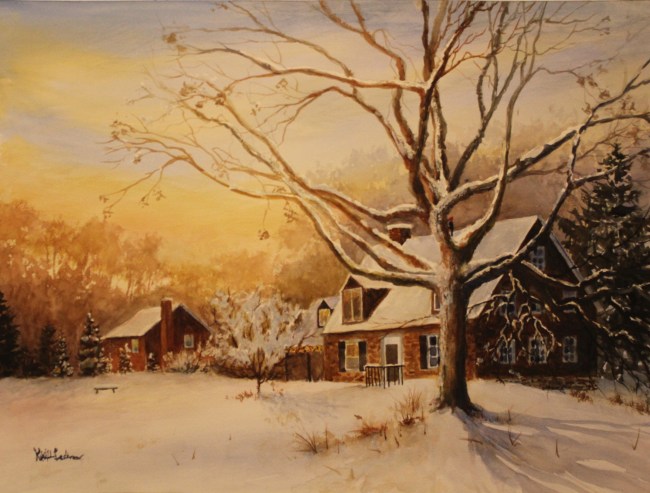
I am thankful for a few good recent snow storms in my neighborhood, which inspired this painting. The house on the right seems to be a “second home”; the light is never on, and there is hardly any sign of life other than an occasional pileated woodpecker in that big old oak tree. On one night in July this year, this place was rockin with about 40 strong, and that was the only time I have ever seen a human soul here. I could be totally off the mark of course, as this might be the residence of Count Dracula. No, perhaps it’s Xavier’s School for Gifted Youngsters. Oh, I guess I’ll never know.

The photograph above of Spiderman’s Aunt’s place left a bit of room for painting imagination….

4 Corner Desolation

Art, Life Balance, Outdoor Adventure

Watercolor on rough paper

I felt the urge to paint such a scene because of what it represents to me; contentedness. We’ve traveled thousands of miles only to find ourselves in complete desolation, at a gas station with a trading post sign and a rusty old truck. This scene is located less than a mile away from the 4 corners national monument at the intersection of 4 states; Arizona, Colorado, New Mexico, and Utah. The area is home to the Navajo people and they take great pride in their land. To an outsider this area may seem empty and uninhabitable, but the people that live here might know the secrets of this land and they are content to live in this unique and beautiful landscape.

Lessons from the Backcountry

Hike of the Week, Life Balance, Outdoor Adventure

Image

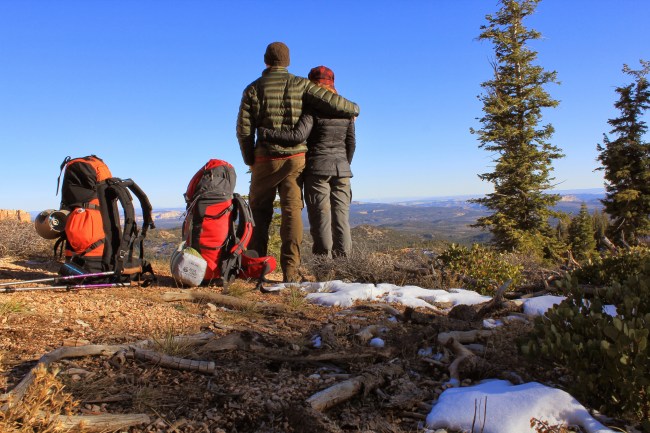
On a recent trip to the southwestern regions of the USA, my hunnie and I explored these regions through a familiar routine of: rent a car, drive to National Park(s), day hike, and stay at lodge. But, this time we spiced things up a bit by adding a pinch of camping and a dash of backpacking into the mix. While I am eager to share funny stories and rave about the geology and the trees of the American Southwest I feel more inclined to share a bit about the thoughts and feelings that came to me during time spent in the backcountry.  This is the first order of business, as I am afraid I will suddenly become unenlightened tomorrow morning.

As we shouldered our heavy packs and began our decent into the Grand Canyon I couldn’t remember why I’d want to spend my days dragging around a giant backpack and my nights waking up to unfamiliar sounds, while pretending that my bladder isn’t begging to be relieved. Was it the obscenely beautiful scenery? Surely, one can attain that without enduring all the hardships by taking a day hike or even scenic drive? Why do we do it? I can’t quite put my finger on it, but maybe it’s a combination of simplicity, physical challenge, self-reliance, the longing for a greater connection with the natural world, and a deeper appreciation for the things we tend to take for granted. In a way, backpacking is like being a track runner; it looks like punishment, but the high you get from it is well worth the discomfort. Here are some lessons I may have revisited on this brief sojourn into the backcountry:

Appreciation

Many Native American tales have a common theme, which is the importance of appreciation and thanksgiving. The Lenape people have a story about a great corn spirit, which took away all the corn from the Lenape people once they stopped giving thanks and began to take the gift of corn for granted. Life in the backcountry makes you appreciate modern conveniences like food in the fridge, flush toilets, and a nice warm heated home. Out there, it takes effort just to boil water to make tea, but it’s also the best bag of Lipton tea you’ll ever have. The backcountry makes Ramen Noodles taste like a gourmet meal and PB&J taste like Ben and Jerry’s. It’s the ultimate lesson in appreciation and thanksgiving.

Humility (well I tried)

Not all backcountry excursions allow for immersion in solitude, especially not the South Kaibab to Bright Angel route in the Grand Canyon. There were many different kinds of folks on the trail and at the campsites doing many different kinds of interesting things. For instance, there was a fellow that believed that hiking out of the canyon was a race to the top. I have no issue with making way for those who are stronger and quicker on trail, but this particular fellow lacked the physical ability to stay ahead, and as a result he kept falling behind, and then passing again with a sudden burst of desperate energy over and over again. Here was a lesson in humility. It took a lot of effort to avoid judgment and negative reactions, and I admit that I soon failed that attempt.

Simplicity

My favorite thing about backpacking is the element of simplicity that comes along with it. No need to pick out an outfit; It’s the same shirt every day. And, there are only three simple things on my mind: 1) what/when to eat, 2) Hey look at that pretty bird, and 3) Where to poop. This type of itinerary allows one to “live deliberately”, as Henry Thoreau once put it. I am not talking on the phone, while reading an email, while making hand signals, while picking my ear. There is no “multitasking” and I am focused on one of the three important things mentioned above. Unless of course, I am distracted by the pretty bird while eating or pooping.

When we reached the bottom of the Grand Canyon we were awestruck by the sight of the rushing mud colored water of the mighty Colorado River. I’ve always imagined the Colorado River to be an emerald green color, which it can be depending on the circumstances and time of year. A great feeling of peace washed over me and I tried to remember that other apathetic and unsettled state of mind we tend to fall into, where all relaxation techniques or the strongest of substances aren’t capable of bringing the kind of peace I felt standing near the river. A few days in the backcountry is the best physical and mental medicine that I know of. We resurfaced at the rim of the canyon a few days later, grinning from ear to ear, and we were downright giddy. These types of feelings don’t come along too often and I’d go as far as calling it “true happiness”. Now I remember why we lug around that giant backpack :)!

Simulating Beverages – Eastern Hemlock

Life Balance, Outdoor Adventure

Thought I’d share an excerpt from a class project called ‘Foraging for Edible Wild Plants in “Government Improved” Natural Areas and Modern Suburbia of North Central New Jersey’.

The Eastern Hemlock

Hemlock ID

Identifying the Eastern Hemlock wasn’t difficult for me. It is my favorite pine tree that is found in the Mid-Atlantic region of the US, so I know it when I see it. The 1-inch (or smaller) cones and tiny flat needles are a dead give-away. I was excited to spot some hemlocks growing near the well-preserved “Estate Gardens” in Hockey Hollow National Park. I ripped off a few small branches in order to prepare a “stimulating beverage” once I returned from the hike. Many thoughts ran through my mind, such as; “that park ranger definitely saw me collect these samples and it looks like he’s headed my way at a brisk pace to give me a lecture or a citation”.

Other thoughts conjured up images of thousands of Washington’s troops dying of starvation and suffering through the bitter cold winters during the late 1700s, right where I stood. I wondered if these soldiers did exactly as I had just done and used the hemlock branches to make tea. This may have been one of the only few sources of food that was available to them during one of the harshest winters on record. There are stories of men eating the bark right off the tree during times of extreme hunger (Martin 1962). The winters were so bad that food supplies could not reach the soldiers.

I was looking forward to my Eastern Hemlock Hot Tea. Not to be confused with poison hemlock, which is extremely poisonous to people and animals and is a member of the parsley family (Peterson 1977). Drinking that sort of tea would get me into serious trouble.

Eastern Hemlock Biology: The Eastern Hemlock is extremely shade tolerant. It can develop with as little as 5% of full sunlight (Ward and Montgomery 2004). They can reach up to 100ft in maturity and can live up to 800 years, but the Eastern Hemlock is extremely vulnerable to drought and wind due to its due to its shallow root system (Brisbin 1970). Eastern Hemlocks are typically found growing in moist to extremely moist soil. This tree does not have any natural defenses against predators that I was able to determine and the bark of the tree is not very strong. However, I admire this tree because it is so majestic and has very different characteristics than other types of pine trees found in this region. It is important to the ecosystem because it provides many other animals (birds, porcupine, etc) with shelter, refuge and food (small birds feed on the Hemlock).

Reproduction: “The Hemlock’s seeds open in the fall and their seeds are dispersed throughout the winter” (Holland 2009). I would imagine the dispersal is possible by winter winds and/or animals moving the seeds.

Pests: The Woolly Adelgid is a pest from Asia that is currently damaging the Eastern Hemlock by depleting the Hemlock’s starch reserves (Ward and Montgomery 2004). Most of the Eastern US is heavily infested with these pests. The ironic thing is that Western Hemlock and other Hemlocks found in Asia are supposedly resistant to the Woolly Adelgid (Ward and Montgomery 2004).

Medicinal Purposes: Tea made from Eastern Hemlock is high in Vitamin C (Peterson 1977). The Eastern Hemlock also contains a high amount of tannins and was historically used to treat digestive, mouth, and throat disorders (naturallyyoursgrocery.com). I have also heard that it was effective in treating scurvy. Native Americans has used the tannins from the Hemlock’s tree bark to treat burns (Holland 2009)

Other Uses: The bark was used for tanning leather and giving it a reddish tone. It was also used for dying wool brown and making pulp (Holland 2009).


Stimulating Beverages – Eastern Hemlock Tea

Tea Preparation:

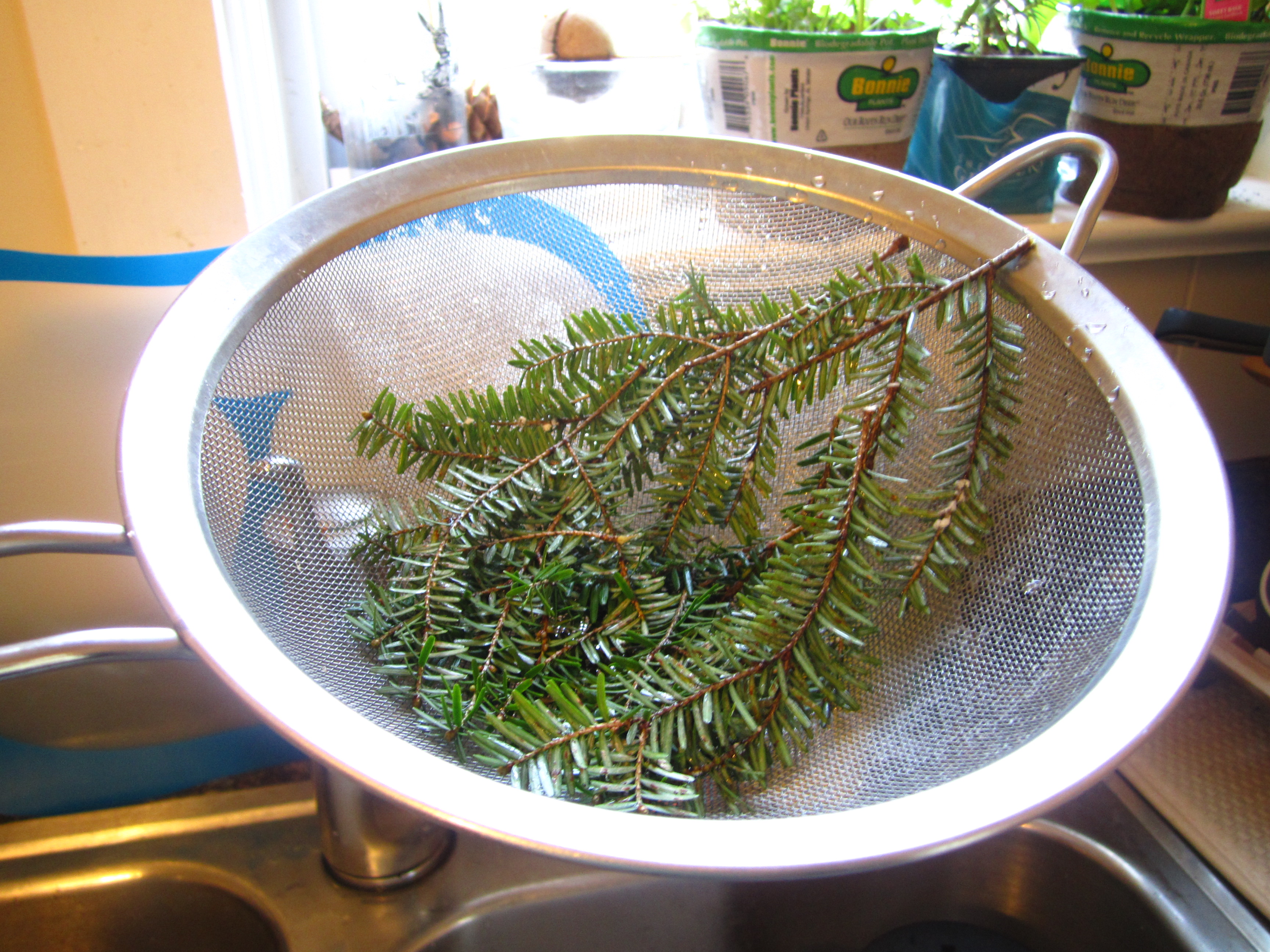
1)      I began by washing the samples I had collected earlier. There were about 8 small branches, which is sufficient for one serving. I used a strainer to wash the branches.
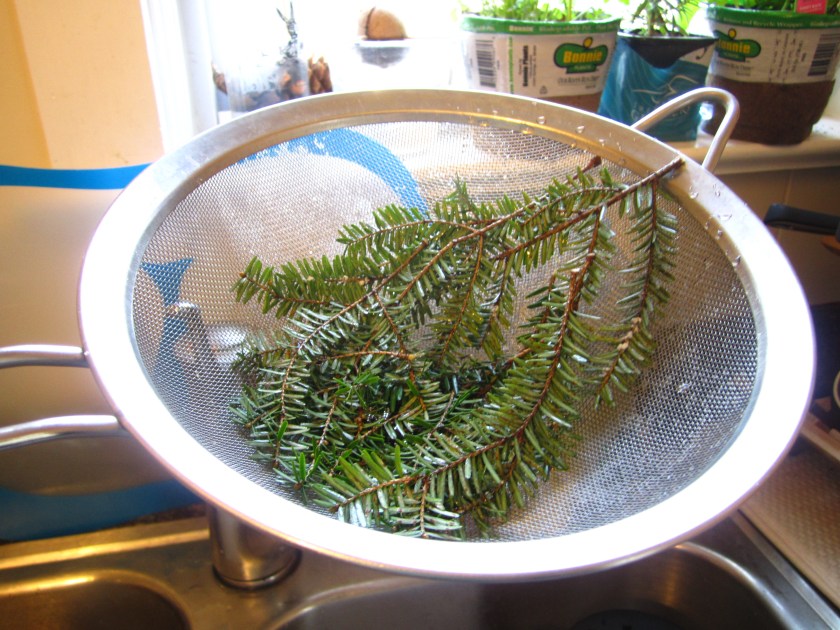
hemlock branches

2)      Rubbed the branches together to release some of flavors (not sure if that was useful).

3)      Brought approximately 2 cups of water to a boil in a small pot.

stove

4)      Placed the Eastern Hemlock branches in the boiling pot, covered, and let simmer for about 20 – 25 minutes.


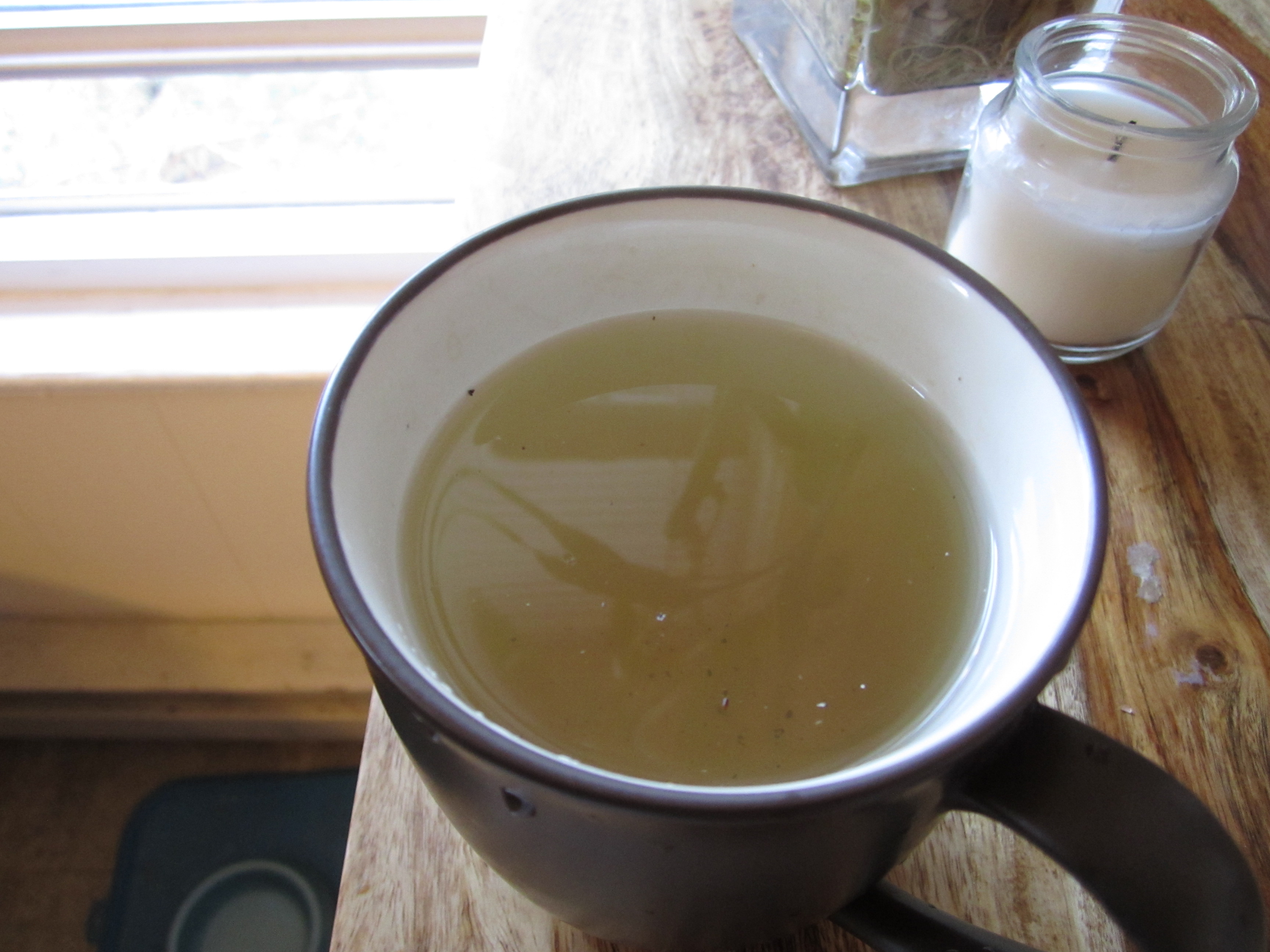
5)      Ready to Serve!
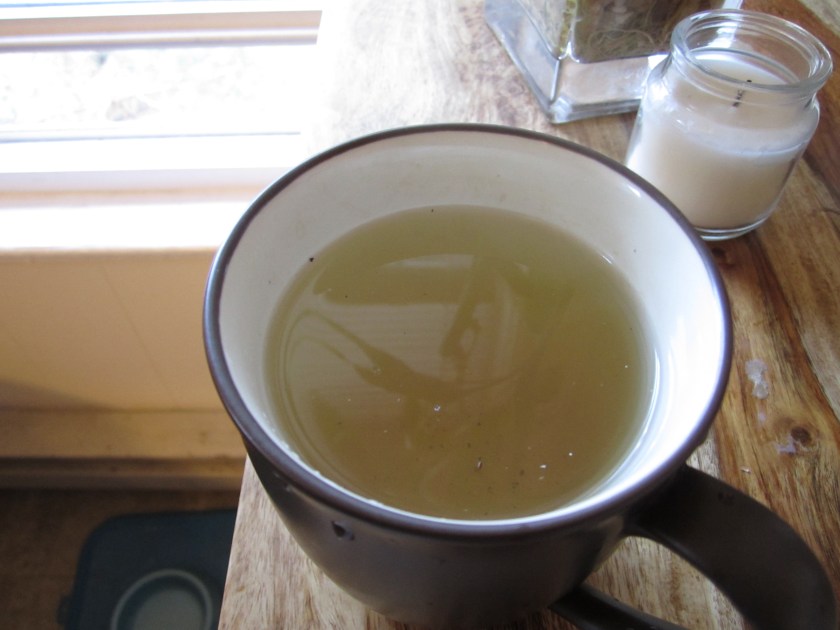
IMG_9617

Experience:

Originally, I had considered adding some honey to the tea if the taste turned out to be worse than I expected. Much to my delight the tea tasted great. It was no better or worse than any of the herbal teas that I have tasted so far. I had expected a turpentine-like taste, but the taste was sweet and rich.

Works Cited

  1. Peterson, Lee Allen. Edible Wild Plants of Eastern and Central North America. New York: Houghton Mifflin Company. 1977. Print.
  2. Martin, Joseph Plum. Private Yankee Doodle. Chapel Hill, North Carolina: Eastern National. 1962. Print.
  3. Ward, S. Jeffrey, Montgomery, E. Michael. Eastern Hemlock Forests: Guidelines to Minimize the Impacts of Hemlock Woolly Adelgid. May 2004. Web Article.   http://na.fs.fed.us/pubs/tps/eastern_hemlock/eastern_hemlock.pdf
  4.  Brisbin, L. Robert. Eastern Hemlock. October 1970. Web Article.http://www.fpl.fs.fed.us/documnts/usda/amwood/239hemlo.pdf
  5.  Holland, Mary. Aubudon Guides. Eastern Hemlocks. November 2009. Web. http://www.audubonguides.com/article.html?id=81

On Your Own Two Feet

Life Balance, New Jersey, Outdoor Adventure

My honey and I live in New Jersey and we’ve recently witnessed the wrath of Hurricane Sandy. The neighborhood we live in looked like a war zone after Sandy blew through the state. 90 MPH winds sent hundreds of giant eastern white pine trees crashing down on electric cables, across major roads (blocking them completely), and in most unfortunate cases; through houses. My grandfather believes that this occurred because New Jersey’s soil is sandy and rocky, which makes it impossible for trees to become deeply rooted into the ground. Luckily, our apartment building had almost no damage. Our hearts go out to those who were less fortunate and we gladly donated our clothing to those who needed it more.

But, I couldn’t help but laugh when I saw how the hurricane affected the dynamics between certain people and their beloved automobiles. Once Sandy had gone, these people suddenly needed to put gas in their cars NOW! No matter what! With all these giant trees blocking the roads, how were they going to get to the supermarket to buy crackers? They would have to do the unthinkable!!! They would have to put one foot in front of the other and walk an entire half a mile to the store to taste those yummy crackers. That’s right you can actually get to the store…by walking there. No need to run over police officers at gas stations or pull guns and axes on old ladies who happen to get ahead of you at the gas pump (yes, this actually happened).

I could go off on a rant about how the hurricane brought out the worst (and the best) in people, but I think we already know that, so let’s take a walk instead. It’s the most natural thing for us to do. That’s why we were created to walk upright on two feet. To me, walking is pure magic! It’s the best thing since sliced bread.

While walking you notice things. Is that a saw-whet Owl…in Jersey (who knew)? Your son or daughter walking beside you now remembers the moment forever. In really late fall you notice the cold gray-blue sky, the smell of dirt and dead leaves, and you feel the chill on your face and bones, and it makes you feel alive. It awakens the senses and inspires creativity. Henry David Thoreau and tons of other literary geniuses had their best ideas come to them in mid stride.

Sadly, I feel that very few of us take walks these days and even fewer are in touch with the natural world. When I tell people at work that I went for a walk after work, they look at me with utter disbelief, as if I said “I went for a walk after work NAKED”. The late great Edward Abbey totally called it back in the 60s when he said that the automobile will lead to the demise of our national parks, monuments, state parks, and forests. Yes sir, no profits to be made if we were to experience our parks mainly on foot or bicycle (other than profits in the form of mental and health wellness, but who cares about that).

Still, I am still hopeful that natural disasters won’t be the thing to finally unplug us from our machines and awaken us into the real world. OK, time to go for a walk 🙂